
Your best prospect just switched project management tools. You found out four weeks later, from a LinkedIn post celebrating the migration. By then, the evaluation is over, the contract is signed, and the champion who pushed for the change has moved on to the next fire.
This is the timing problem that firmographic data cannot solve. Company size, industry, and revenue tell you who might buy. They tell you nothing about when. A 500-person logistics company is a great fit on paper whether it is mid-contract, mid-renewal, or mid-migration, and your outreach lands with the same blind weight in all three cases.
Technographic data changes that. When you can see what tools a company runs, and when those tools change, you get a window into their buying cycle that competitors relying on static firmographics never see. And in 2026, that window matters more than ever: industry analyses of B2B lead generation consistently point to behavioral and intent-layer signals, layered on top of traditional qualification data, as the primary differentiator between teams that hit quota and teams that chase cold lists (dwmedia.com, blueprintbusinesssolutionscorp.com).
Key takeaways:
- Technographic data reveals a prospect's tool stack and, more importantly, when that stack changes, giving you a buying-cycle window firmographics cannot provide.
- The four highest-converting technographic triggers are competitor adoption, competitor removal, adjacent-tool adoption, and stack-related hiring signals.
- Stack the qualification formula (trigger × fit × authority) to turn raw signals into priority accounts instead of noise.
- Competitor contract expiry outreach works best when started 90 to 120 days before an estimated renewal date.
- LeadOcean segments wired into Eaglet turn detected signals into triggered sequences automatically, and a refreshing watchlist keeps pipeline full without manual research.
Here is how to build that system.
Table of Contents
- Why Firmographic Targeting Alone Leaves 80% of Pipeline Timing on the Table
- What Technographic Signals Are, and Why Tool-Stack Data Predicts Purchase Intent
- The Four Highest-Converting Technographic Triggers in B2B Sales (With Examples)
- How to Build a Technographic Segment in LeadOcean: Filters, Logic, and Output
- Stacking Technographic Signals With Firmographic Fit: The Qualification Formula That Removes Guesswork
- Competitor Contract Expiry Outreach: How to Write the Email That Wins the Switch
- Automating the Sequence: Wiring LeadOcean Segments Into Eaglet for Triggered Outreach
- Syncing Technographic Segments to HubSpot and Salesforce for Full Pipeline Visibility
- Measuring Signal Quality: Which Technographic Data Sources Produce the Best Conversion Rates
- Building a Living Technographic Watchlist That Refreshes Pipeline Without Manual Research
Why Firmographic Targeting Alone Leaves 80% of Pipeline Timing on the Table
Firmographics answer one question: does this account look like our best customers? That is a necessary filter, but it is a filter on fit, not on readiness. Two companies with identical headcount, industry, and revenue can be months apart in buying readiness, and your CRM has no way to tell them apart.
The result is a pipeline built on probability rather than timing. You blast a list of 2,000 lookalike accounts, knowing from experience that maybe 2% are in an active buying cycle at any moment. Your message reaches the other 98% at the wrong time, gets ignored, and burns the account for a future sequence.
Here is the problem: the buying cycle has not gotten shorter, but the visibility into it has gotten better, and your competitors are using that visibility. Teams that trigger outreach on live signals, rather than static lists, consistently report higher reply rates and shorter sales cycles. We covered the mechanics of this in our guide to turning buying signals into booked meetings, and the pattern holds across signal types. The gap is that most signal strategies stop at intent topics and website visits. They miss the richest signal category of all: what the prospect has already bought.
What Technographic Signals Are, and Why Tool-Stack Data Predicts Purchase Intent
Technographic data is the record of which technologies a company uses, detected from job postings, website scripts, public DNS records, app marketplace listings, and similar observable footprints. Where firmographics describe the company, technographics describe its stack.
Why does the stack predict purchase intent so well? Three reasons.
First, tools cluster. A company running HubSpot, Gong, and Outreach is demonstrably willing to invest in revenue tooling. A company on spreadsheets and a legacy on-prem CRM is not, no matter how good the fit looks on paper. The stack is a revealed preference, not a stated one.
Second, stack changes are events, not attributes. When a company adds a competitor product to its website, posts a job listing mentioning your category, or drops a tool it has run for years, something operational has happened. Someone owns a budget, felt a pain, and acted. That person is in motion right now.
Third, integrations create urgency. If your product sits in a workflow next to a tool the prospect just adopted or just ripped out, the timing of their decision is no longer abstract. It is now.
This is the same logic behind the 48-hour activation window we described in our post on converting buying signals before competitors see them: the value of a signal decays fast, and the teams that win are the ones whose detection-to-outreach lag is measured in hours.
The Four Highest-Converting Technographic Triggers in B2B Sales (With Examples)
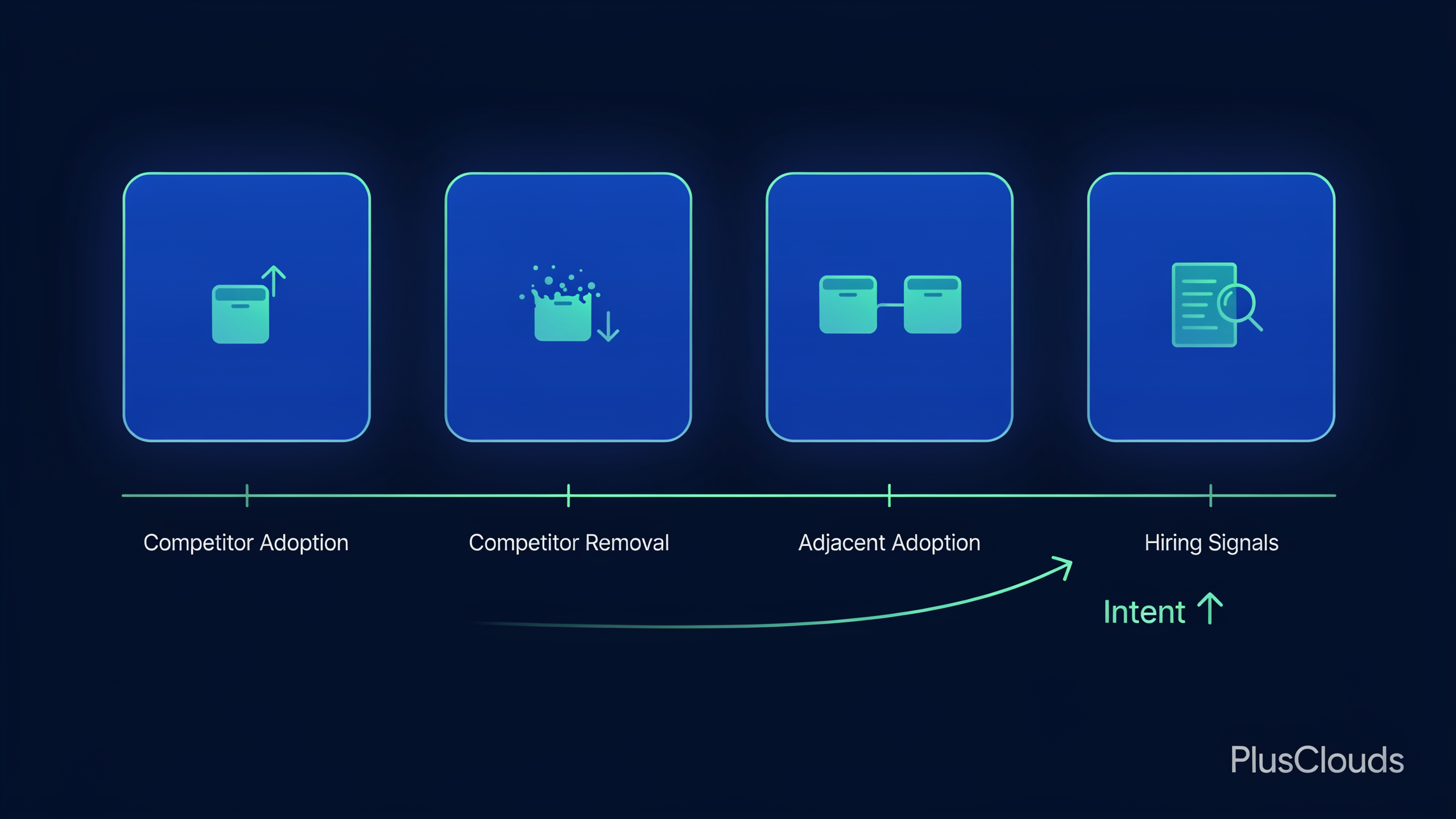
Not all technographic changes carry equal weight. These four trigger types convert at the top of the range in practice, because each one maps to a specific stage of an active evaluation.
1. Competitor adoption. The prospect installs your competitor's product. Counterintuitive as it sounds, this is a strong positive signal: it confirms the category budget exists, the pain is real, and a decision-maker is engaged. The play is not to bash the competitor. It is to position against the specific limitations that will surface in month three, when the prospect discovers what the shiny onboarding did not cover.
2. Competitor removal. The prospect drops a competitor's script from their site or stops mentioning it in job posts. This is the highest-intent trigger of the four. Someone is actively dissatisfied and the seat is empty. Reach out within days, not weeks.
3. Adjacent-tool adoption. The prospect adopts a tool that integrates with, or competes with a workflow touching, your product. A company that just deployed Snowflake is suddenly far more receptive to data pipeline, governance, and analytics tooling. You are not selling into a vacuum; you are selling into a project that already has budget and momentum.
4. Stack-maturity signals. Job postings are the underrated one. A posting for a "RevOps Manager with experience in Salesforce and Clari" tells you the company is building the exact workflow your product plugs into, months before any procurement activity becomes visible. Hiring for a tool is a leading indicator of buying that tool.
Each of these triggers answers the question firmographics never can: why now?
How to Build a Technographic Segment in LeadOcean: Filters, Logic, and Output
LeadOcean searches more than 1.8 billion company records and lets you filter on detected technologies alongside firmographics and buying signals. Building a technographic segment is a matter of translating the trigger types above into filter logic.
A practical workflow:
- Start with your ICP firmographics as the base layer: industry, headcount band, geography, revenue. This keeps the segment small enough to be actionable. If you need a refresher on defining that base layer, our ICP-to-pipeline flywheel guide walks through it step by step.
- Add the technographic filter. Select the technologies relevant to your trigger. For competitor removal, select your competitor's product. For adjacent adoption, select the integration-adjacent tool.
- Combine triggers with OR logic, constrain with AND logic. For example: (uses Competitor A OR uses Competitor B) AND (industry = fintech) AND (headcount 200 to 2,000). Mixing logic levels deliberately is what separates a segment from a keyword search.
- Layer in recency. A stack change detected last week is worth ten stack changes detected last year. Filter on signal recency wherever the data supports it.
- Resolve to decision-makers. A company using the wrong tool is not a lead. The VP of Engineering who owns the tooling budget is. LeadOcean resolves the account to verified decision-maker contacts, so the segment output is people you can actually sequence, not logos you have to research.
The output is a named, saved segment that refreshes as new technographic data comes in. That last part matters: a segment built once and exported once is a list. A segment that refreshes is a watchlist, which we will return to later.
Stacking Technographic Signals With Firmographic Fit: The Qualification Formula That Removes Guesswork
Technographic triggers on their own produce noise. A 12-person startup dropping a competitor's tool is a data point, not a deal. The qualification formula that works stacks the two layers:
Trigger (technographic) × Fit (firmographic) × Authority (decision-maker role) = priority account.
Score it explicitly. Give each account a fit score from your ICP criteria, a trigger score based on which technographic event fired and how recent it is, and an authority score based on whether the resolved contact owns the budget or merely uses the tool. Accounts that clear a threshold on all three go to outbound immediately. Accounts that trigger but score poorly on fit go into a nurture track instead of a sequence.
This is exactly the scoring architecture we detailed in our guide to building a CRM-native lead scoring engine on LeadOcean signals, and technographic triggers slot into it as just another weighted signal input. The benefit of a scored approach is political as much as technical: when your SDR team lead asks why an account is at the top of the call list, the answer is a number with components, not a hunch.
Competitor Contract Expiry Outreach: How to Write the Email That Wins the Switch
Most SaaS contracts run on annual or multi-year cycles, which means every competitor customer has a predictable moment of reconsideration. Contract expiry outreach is the practice of timing your sequence to that window, typically starting 90 to 120 days before renewal.
You will rarely see the exact contract date. You infer it from proxies: the competitor's typical contract length, the prospect's own renewal patterns, funding anniversaries, fiscal year ends, and the date the competitor tool first appeared in the prospect's stack. Build the estimate, store it as a field on the account, and let it drive sequence timing.
The email itself follows three rules.
Lead with the trigger, not the pitch. "I noticed [Company] recently moved off [Competitor]" beats "I wanted to introduce myself" every time, because it proves you did homework the prospect did not expect.
Name the migration pain, not the feature list. Teams switching tools fear data migration and workflow disruption more than they desire features. Address the switch cost directly and you earn the reply.
Time the ask to the window. Ninety days out, the ask is a conversation about evaluation criteria. Thirty days out, it is a migration plan and a side-by-side comparison. Asking for a demo on day one of a 12-month contract wastes the trigger.
Automating the Sequence: Wiring LeadOcean Segments Into Eaglet for Triggered Outreach
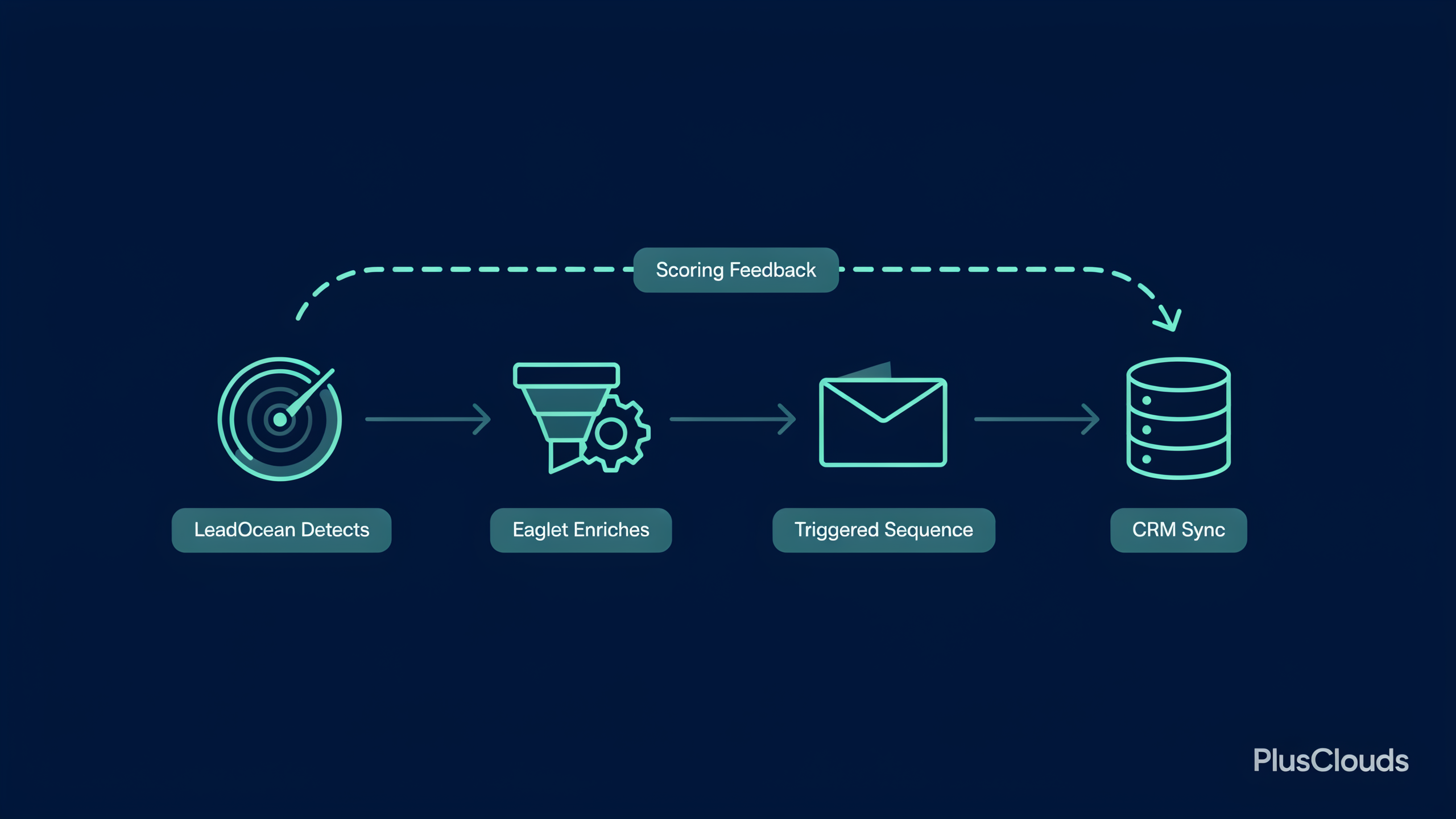
Manual trigger monitoring does not scale. The point of a technographic system is that when a signal fires, outreach starts without anyone refreshing a dashboard.
This is where Eaglet by PlusClouds comes in as the execution layer. Eaglet takes the segments you build in LeadOcean and runs enrichment, sequencing, and CRM sync automatically, so a competitor-removal event detected on Monday becomes a personalized first-touch email on Tuesday morning.
The wiring looks like this:
- LeadOcean detects the technographic change and updates the saved segment.
- Eaglet enriches the new records (role verification, company context) and assigns them to the sequence variant matched to their trigger type. Competitor removal gets the switch-cost email; adjacent adoption gets the integration-angle email.
- Message personalization pulls from the specific signal, so the email references the actual tool change rather than a template with a merge field.
- Replies and engagement route back into the CRM, where the scoring engine updates the account's priority.
For teams that want to push this further, we mapped a fully autonomous version of this architecture in our agentic prospecting workflow post, where research, sequencing, and follow-up run with minimal human input. The technographic triggers described here are among the highest-value inputs that kind of system can consume. And if you are operating in the EU, the same automation carries GDPR obligations; our guide to GDPR-compliant AI outreach with LeadOcean and Eaglet covers the lawful-basis and documentation requirements before you scale.
Syncing Technographic Segments to HubSpot and Salesforce for Full Pipeline Visibility
A trigger that lives only in a prospecting tool is invisible to the rest of the revenue team. Sync the segment into HubSpot or Salesforce so the trigger data lands on the account record itself.
Three fields make the difference in practice:
- Trigger type (competitor removal, competitor adoption, adjacent adoption, hiring signal)
- Trigger date, which drives sequence timing and contract-expiry estimates
- Trigger source, so you can later measure which signal categories actually convert
Once those fields exist, everything downstream improves. Reps open an account and see why it is hot. Managers build reports on trigger-to-meeting conversion by type. Marketing can suppress accounts in active trigger windows from generic nurture campaigns that would dilute the outbound motion. We covered the full CRM-side automation pattern in our buying signal CRM playbook, and the same workflow applies here with technographic fields in place of intent topics.
Measuring Signal Quality: Which Technographic Data Sources Produce the Best Conversion Rates
Not every technographic data source is equally predictive, and the only way to know which ones work for your product is to measure trigger-to-meeting conversion by source.
Track these four metrics per source:
- Precision: what share of detected changes are real (false positives from script remnants and stale crawls are the main enemy)
- Recency lag: how quickly a real-world change shows up in the data
- Trigger-to-reply rate: the cleanest proxy for relevance
- Trigger-to-meeting rate: the number that decides budget
In most stacks, job postings and website script changes are the freshest sources, while app marketplace and review-platform data is slower but higher-confidence. After a quarter of measurement, the fastest improvement available to most teams is cutting the lowest-quality source from their trigger logic entirely. Fewer, better triggers beat volume every time, because every false trigger burns an account you may want to sequence credibly six months later.
Building a Living Technographic Watchlist That Refreshes Pipeline Without Manual Research
The end state of this system is a watchlist, not a list. A list is exported once and decays from the day you download it. A watchlist is a saved LeadOcean segment with your firmographic base, your technographic trigger filters, and your recency constraints, continuously refreshed as new stack data arrives.
Operationalize it with a simple cadence:
- New records entering the segment are enriched and scored automatically through Eaglet.
- Accounts clearing the qualification threshold enter the trigger-matched sequence.
- Accounts that trigger but fail fit scoring are parked in nurture with a re-evaluation date.
- A weekly review checks precision: sample ten new trigger events, verify them manually, and adjust filters if the false-positive rate creeps up.
After the initial build, the system runs with a few hours of oversight per week instead of days of manual research. Pipeline stops depending on someone remembering to check a competitor's customer page.
The shift here is conceptual before it is technical. Firmographics tell you who to talk to. Technographics tell you when to talk to them, and timing is what separates a reply from a delete. Build the segment, stack it with fit scoring, wire it into Eaglet for triggered sequences, and let the watchlist refill your pipeline on its own schedule instead of yours.
If you want to see this running on real data, start a LeadOcean trial, build your first technographic segment against your competitor's tool, and connect it to Eaglet by PlusClouds to watch the first trigger fire into a live sequence. The next contract expiry in your market is already on the calendar. The only question is whose sequence reaches it first.