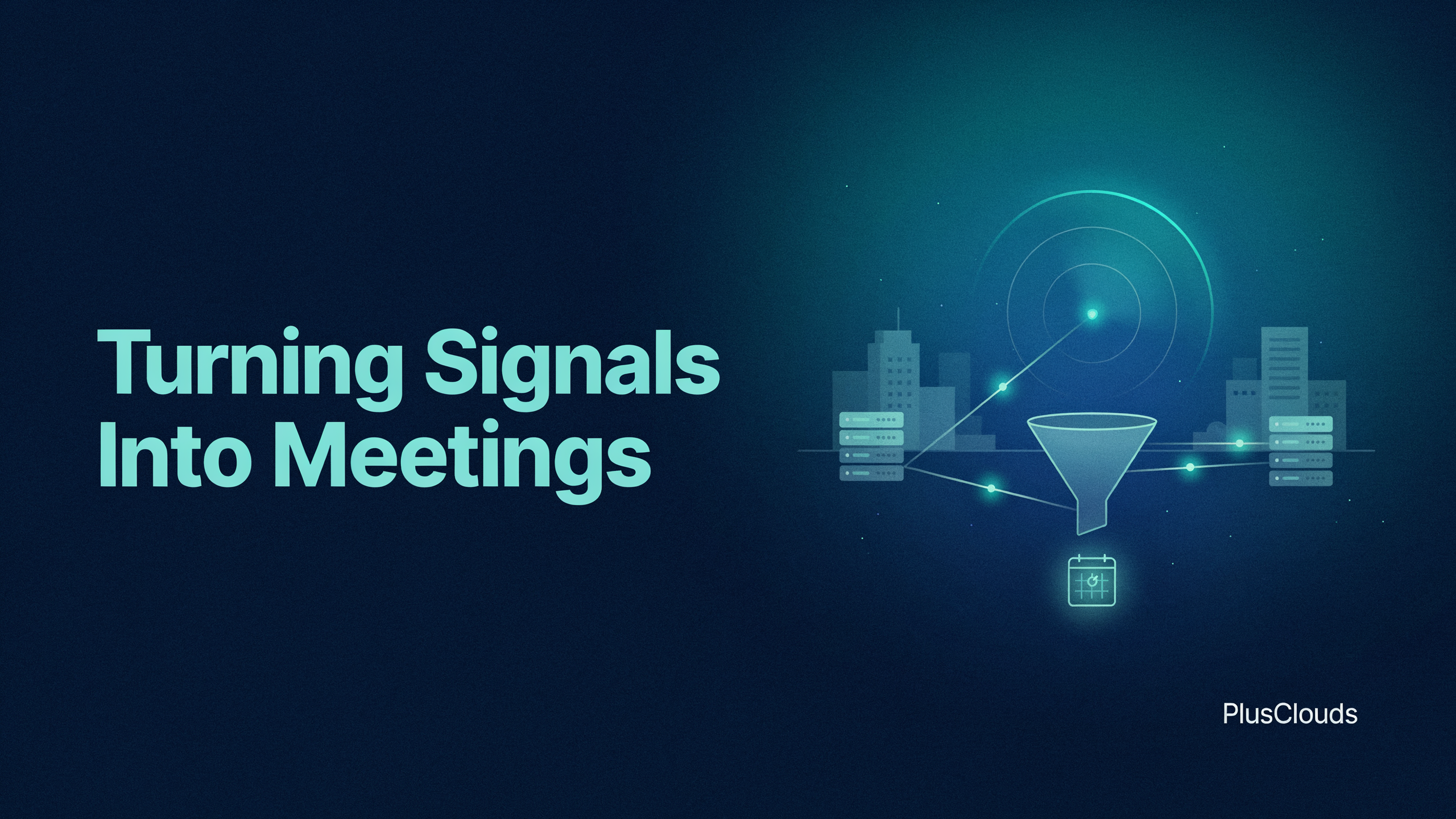
Your best prospect just finished reading three comparison articles about solutions like yours. They visited pricing pages, downloaded a vendor report, and asked a question in an industry Slack group. None of this touched your website. None of it showed up in your CRM. And by the time they finally fill out a form, three of your competitors have already pitched them.
This is the gap that B2B intent data exists to close. Instead of waiting for buyers to raise their hands, intent data lets you see the hand-raising behavior as it happens, across the open web, and act on it while the buying window is still open. The market reflects how badly teams want this: B2B intent data is estimated to be a $4.5 billion market in 2026, growing at roughly 15.9% CAGR (MarketBetter).
Key takeaways:
- B2B intent data is behavioral evidence that an account is actively researching your category, and most of the buying journey happens anonymously before a buyer ever contacts a vendor.
- Third-party intent tells you who is in-market; first-party intent tells you how far along they are. Serious teams use both.
- Not all signals are equal. Require corroboration across multiple signals before spending outreach effort, and prioritize decision-stage signals like pricing visits and competitor searches.
- Signals only produce revenue when they surface inside the CRM and trigger outreach within hours. Speed-to-lead, not data coverage, is the real differentiator.
- AI match engines shift the game from reacting to observed signals to predicting buyer readiness, surfacing in-market B2B accounts before competitors see them.
This guide breaks down what intent data actually is, how to separate useful signals from noise, and how to wire signals into your CRM and outreach motion so they turn into booked meetings rather than dashboard trivia.
Table of Contents
- What Is B2B Intent Data and Why It Has Become a Revenue Necessity
- First-Party vs. Third-Party Intent Signals: Understanding the Difference
- The Buying Signal Hierarchy: From Weak to High-Priority Signals
- How to Layer Multiple Signals Before Triggering Outreach
- Intent Data and CRM Integration: Surfacing Signals Where Reps Already Work
- Speed-to-Lead: Why Real-Time Signal Activation Is the Competitive Edge
- Building an Account-Level Intent Profile for the Entire Buying Committee
- Common Intent Data Mistakes That Burn Pipeline and How to Avoid Them
- How AI Match Engines Predict Buyer Readiness Before a Search Is Ever Made
- Activating Intent Data with AI Outreach: From Signal to Sequence in Minutes
- Conclusion: Signals Are Cheap, Activation Is the Moat
What Is B2B Intent Data and Why It Has Become a Revenue Necessity
B2B intent data is behavioral evidence that an account is actively researching a problem or solution category. It comes from content consumption, search activity, review-site visits, downloads, and engagement patterns that indicate where an organization sits in its buying journey.
The reason it has shifted from "nice to have" to "revenue necessity" is structural. B2B buyers now complete most of their research anonymously, long before they talk to sales. Various industry analyses consistently show that the majority of the buying journey happens before a buyer ever contacts a vendor (Madison Logic). If your only visibility into demand is form fills, you are competing for the tail end of a process you never saw.
Intent data flips the math on outbound. Cold outreach to a random list of accounts fights against timing; outreach to an account that is demonstrably in-market works with timing. That is why teams using intent-driven prospecting report meaningfully higher reply and meeting rates than teams working static lists (Landbase).
First-Party vs. Third-Party Intent Signals: Understanding the Difference
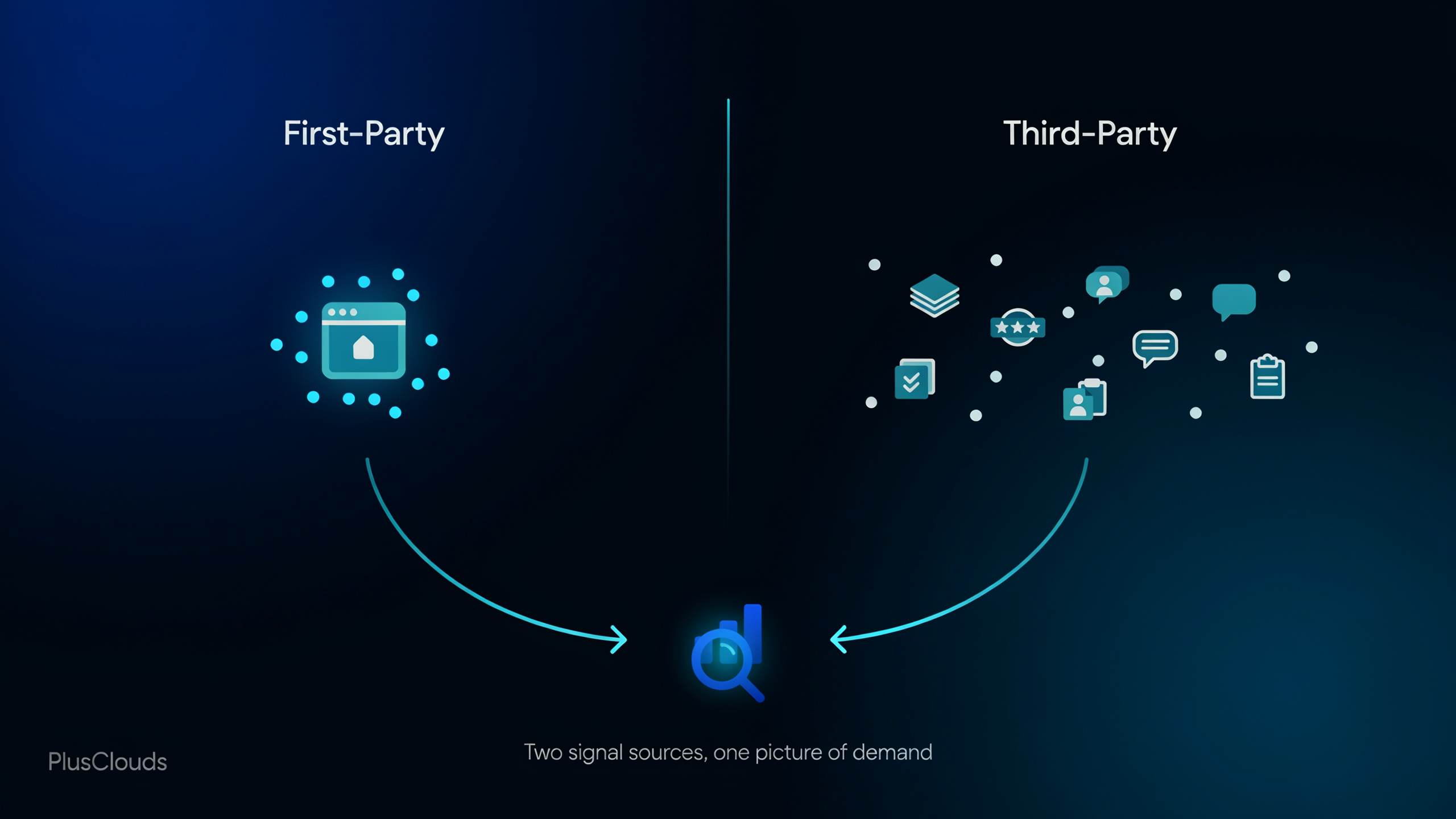
Not all intent data comes from the same place, and the distinction matters for how you act on it.
First-party intent is generated on properties you own and control:
- Website visits, including which pages were viewed and for how long
- Pricing page visits and product page engagement
- Content downloads, webinar registrations, and email engagement
- Product usage data and trial activity
First-party signals are high-accuracy but narrow. They only tell you about accounts that already found you. They say nothing about the much larger group of in-market buyers researching your category who have never touched your site.
Third-party intent is collected from networks outside your properties: publisher co-ops, review platforms, ad exchanges, and content syndication networks. It is broader and earlier-stage. It can surface an account researching "data warehouse pricing" across dozens of publications even if they have never heard of your company.
The practical takeaway: third-party intent tells you who is in-market, first-party intent tells you how far along they are. Serious teams use both. If you want to go deeper on the first-party side, we covered how to build a first-party intent stack that feeds LeadOcean in a separate guide.
The Buying Signal Hierarchy: From Weak to High-Priority Signals
Treating all signals equally is the fastest way to burn your SDR team's calendar. Signals vary enormously in strength, and a simple hierarchy keeps prioritization honest.
Weak signals (awareness stage):
- Generic topic reads, such as an article about "digital transformation"
- A single visit to an educational blog post
- Following an industry influencer
Medium signals (consideration stage):
- Multiple research sessions on solution-category content
- Engagement with comparison and "alternatives to X" content
- Review-site profile views on G2, Capterra, or similar platforms
Strong signals (decision stage):
- Pricing page visits
- Searches containing your brand or competitor brand names
- Job postings that indicate budget allocation (hiring a "marketing automation manager" suggests investment in that stack)
- Multiple stakeholders from the same account engaging within a short window
- Trial signups or demo page visits
A useful rule of thumb: the more specific the content and the more people from the account involved, the hotter the signal. One junior employee reading a generic article is a weak signal. Three people from the same company reading vendor comparison pages in one week is a buying committee in motion.
How to Layer Multiple Signals Before Triggering Outreach
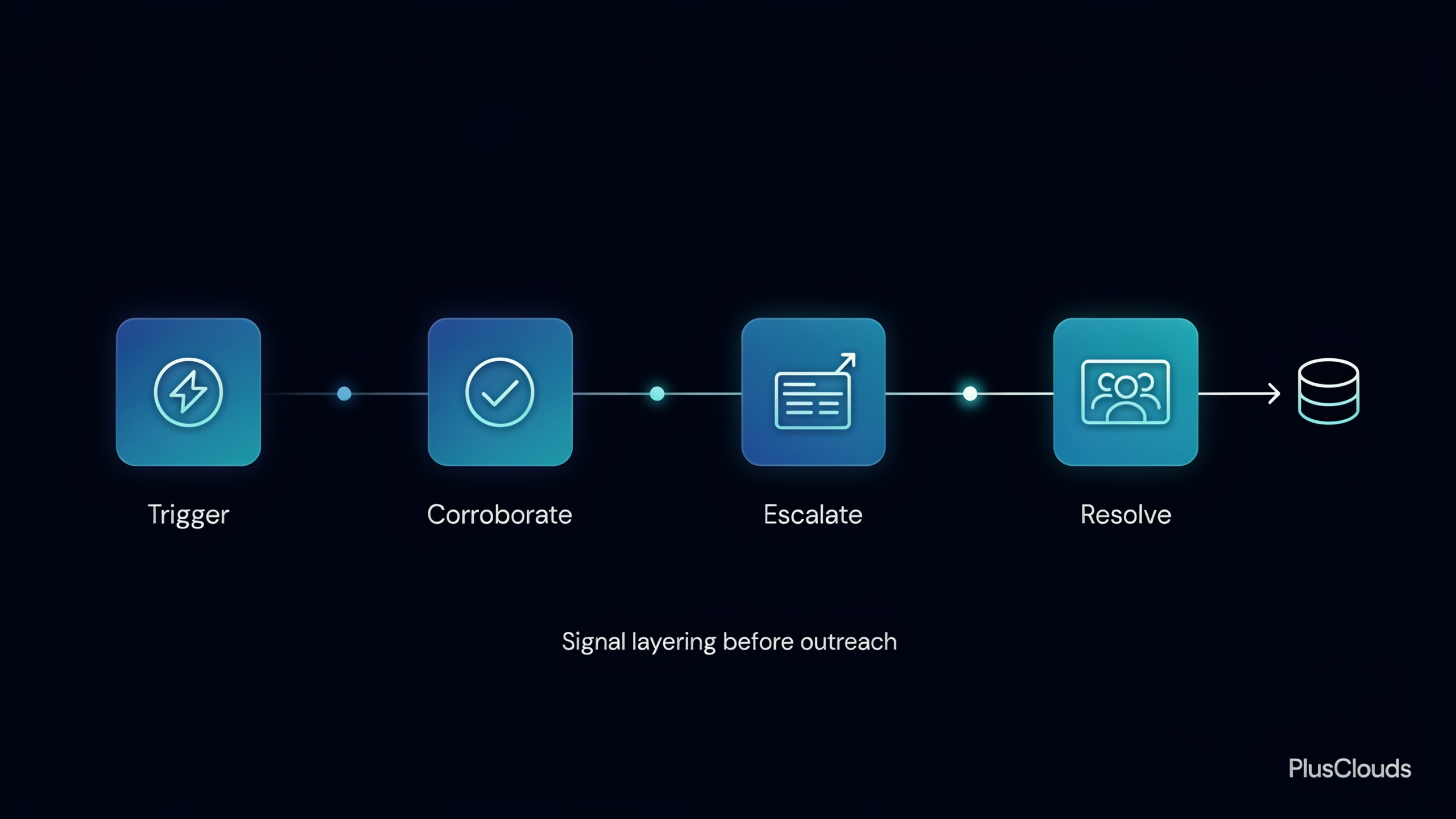
A single signal, even a strong one, is a hypothesis. A cluster of signals is a conclusion. The difference between amateur and professional intent programs is the willingness to require corroboration before spending outreach effort.
A practical layering model looks like this:
- Trigger signal: A third-party spike in category research puts the account on your radar.
- Corroborating signal: First-party data confirms engagement, or firmographic fit confirms the account matches your ICP.
- Escalation signal: Decision-stage behavior appears, such as pricing interest or competitor comparison.
- Contact-level resolution: You identify the specific people involved, not just the account.
Only at step four do you have what you need: the right company, at the right time, with the right people identified. This is exactly the workflow an ICP-to-pipeline flywheel is built around, where firmographic filters, buying signals, and AI matching combine so your CRM fills with accounts that are ready now rather than someday.
Platforms like LeadOcean by PlusClouds operationalize this layering directly: the platform searches a database of over 1.8 billion companies, applies buying-signal detection, and uses an AI Match Engine to surface accounts that combine ICP fit with active in-market behavior, then resolves them to verified decision-maker contacts.
Intent Data and CRM Integration: Surfacing Signals Where Reps Already Work
Here is a hard truth about intent data: if it lives in a separate dashboard, it will be ignored. Reps do not log into yet another tool between calls. Signals have to arrive inside the systems where work actually happens.
Effective intent data CRM integration means:
- Intent spikes automatically create or enrich account records in HubSpot or Salesforce
- Signal scores appear as fields reps see on the account and contact views
- High-priority signals trigger tasks, sequences, or alerts without manual triage
- Outreach activity writes back so signal data and engagement history live together
LeadOcean handles this with native HubSpot and Salesforce integration, so a matched in-market account flows into your CRM with its contacts attached, no CSV exports involved. The alternative, asking SDRs to check a third portal daily, reliably produces the same result: the portal gets checked once a week, and the freshest signals go stale.
Speed-to-Lead: Why Real-Time Signal Activation Is the Competitive Edge
Intent data has a shelf life, and it is short. Research on buying windows suggests that the period between a signal firing and a decision being made can compress dramatically, especially in competitive categories. The team that reaches the account first often shapes the shortlist; the team that reaches them second competes against a shortlist someone else built.
This is why speed-to-lead has become the real differentiator in intent-driven sales, not data coverage. Two companies can subscribe to the same intent feeds. The one that activates signals within hours wins disproportionately. We broke down the mechanics of this in detail in The 48-Hour Activation Window, which walks through turning a buying signal into a booked meeting before your competitor even sees it.
Real-time activation requires three things working together: signal detection that fires immediately, contact resolution that happens automatically, and outreach that launches without waiting for a rep to manually build a list. Remove any one of the three and your speed advantage evaporates.
Building an Account-Level Intent Profile for the Entire Buying Committee
B2B purchases are committee decisions. Gartner's research on B2B buying has long shown that typical purchase decisions involve somewhere between six and ten stakeholders, each with their own concerns and research habits. Your CFO cares about total cost. Your VP of Engineering cares about integration risk. They do not read the same content, and they do not respond to the same message.
An account-level intent profile stitches these threads together:
- Which departments within the account are showing research activity
- Which specific individuals are engaging, and what their roles suggest about their priorities
- Whether the signal pattern indicates early exploration or active vendor evaluation
- What content themes dominate, which tells you which pain points to lead with
This is what separates account-level relevance from spray-and-pray. When your SDR emails the CFO about cost consolidation and the technical lead about architecture, both messages land because both are grounded in observed behavior. Platforms like LeadOcean resolve accounts to verified decision-maker contacts across functions, so the committee view comes built in rather than assembled by hand.
Common Intent Data Mistakes That Burn Pipeline and How to Avoid Them
Intent programs fail in predictable ways. Avoid these five:
1. Treating intent scores as gospel. A high score is an invitation to investigate, not a guarantee. Always verify with a quick look at the account before outreach.
2. Ignoring ICP fit. An in-market account that can never afford you is not a lead. Fit and intent are separate filters, and both must pass. Intent without fit wastes outreach; fit without intent wastes time.
3. Sending the same message regardless of signal type. A pricing-page visitor and a top-of-funnel researcher need completely different sequences. Using one template for both is how intent data gets a bad reputation.
4. Acting on stale signals. A spike from six weeks ago is history, not opportunity. If your workflow cannot activate within days, the data's value decays faster than you use it.
5. Measuring activity instead of outcomes. The metric that matters is meetings booked from signal-triggered accounts, not how many signals your platform detected. If the dashboard is impressive and the calendar is empty, the workflow is broken somewhere between detection and outreach.
How AI Match Engines Predict Buyer Readiness Before a Search Is Ever Made
The newest development in intent data is a shift from reacting to signals toward predicting them. Traditional intent tells you what an account has already done. AI match engines model what an account is likely to do next, based on patterns across millions of similar buying journeys.
An AI Match Engine works by combining firmographic fit, technographic data, and behavioral signals, then scoring accounts against the profiles of accounts that converted historically. The output is a ranked list of accounts where readiness is predicted, not just observed. For a deeper look at how buying signals and AI matching feed a working pipeline, Dark Funnel Prospecting covers how to reach buyers before they ever fill out a form.
The practical benefit is coverage. Observed intent only surfaces accounts already leaving footprints. Predictive models surface lookalike accounts that are statistically likely to enter the market, letting you build presence before the buying window opens. LeadOcean's AI Match Engine applies this logic across its 1.8 billion company database, pairing predicted readiness with verified contacts so the output is actionable, not theoretical.
Activating Intent Data with AI Outreach: From Signal to Sequence in Minutes
Detection without activation is just expensive curiosity. The final mile, turning a firing signal into a personalized sequence landing in the right inbox, is where most intent programs stall, because manual sequence-building cannot keep pace with signal volume.
This is where AI outreach automation changes the economics. When a signal fires, the workflow should look like this:
- Signal detected and scored automatically
- Account matched against ICP and enriched with verified contacts
- Message angle selected based on the signal type (pricing interest gets a different email than category research)
- Sequence launched across email and LinkedIn within minutes
- Replies routed to a human SDR for the conversation that actually closes
Eaglet by PlusClouds handles this activation layer, running AI-driven outreach sequences that trigger off detected signals, either standalone or as a LeadOcean add-on. The combination covers the full path: LeadOcean finds and matches in-market accounts, Eaglet engages them. For teams orchestrating across multiple channels, our guide to wiring LeadOcean and Eaglet into an omnichannel sequence shows how coordinated email, LinkedIn, and phone touches multiply reply rates. And if you are designing the sequences themselves, these battle-tested B2B email templates are a solid starting point.
Conclusion: Signals Are Cheap, Activation Is the Moat
Intent data in 2026 is not a differentiator by itself. Every serious competitor can buy the same feeds. What separates teams is what happens in the minutes and hours after a signal fires: whether it reaches a rep's queue, whether the right contact gets identified, and whether a relevant message lands while the buying window is still open.
If you are evaluating how this would work in your own pipeline, start by looking at LeadOcean to see how signal detection and AI matching surface in-market accounts, then explore Eaglet to see how those accounts turn into running outreach sequences. The gap between seeing a signal and booking the meeting is where revenue lives, and closing that gap is a workflow problem you can solve this quarter.