*Key takeaways:
- Roughly 3 to 5% of your total addressable market is in an active buying cycle at any moment, but single-signal prospecting only surfaces a sliver of those accounts.
- Multi-signal outreach grounded in a coherent story earns 25 to 40% reply rates versus 1 to 3% for generic emails, per 2026 benchmarks.
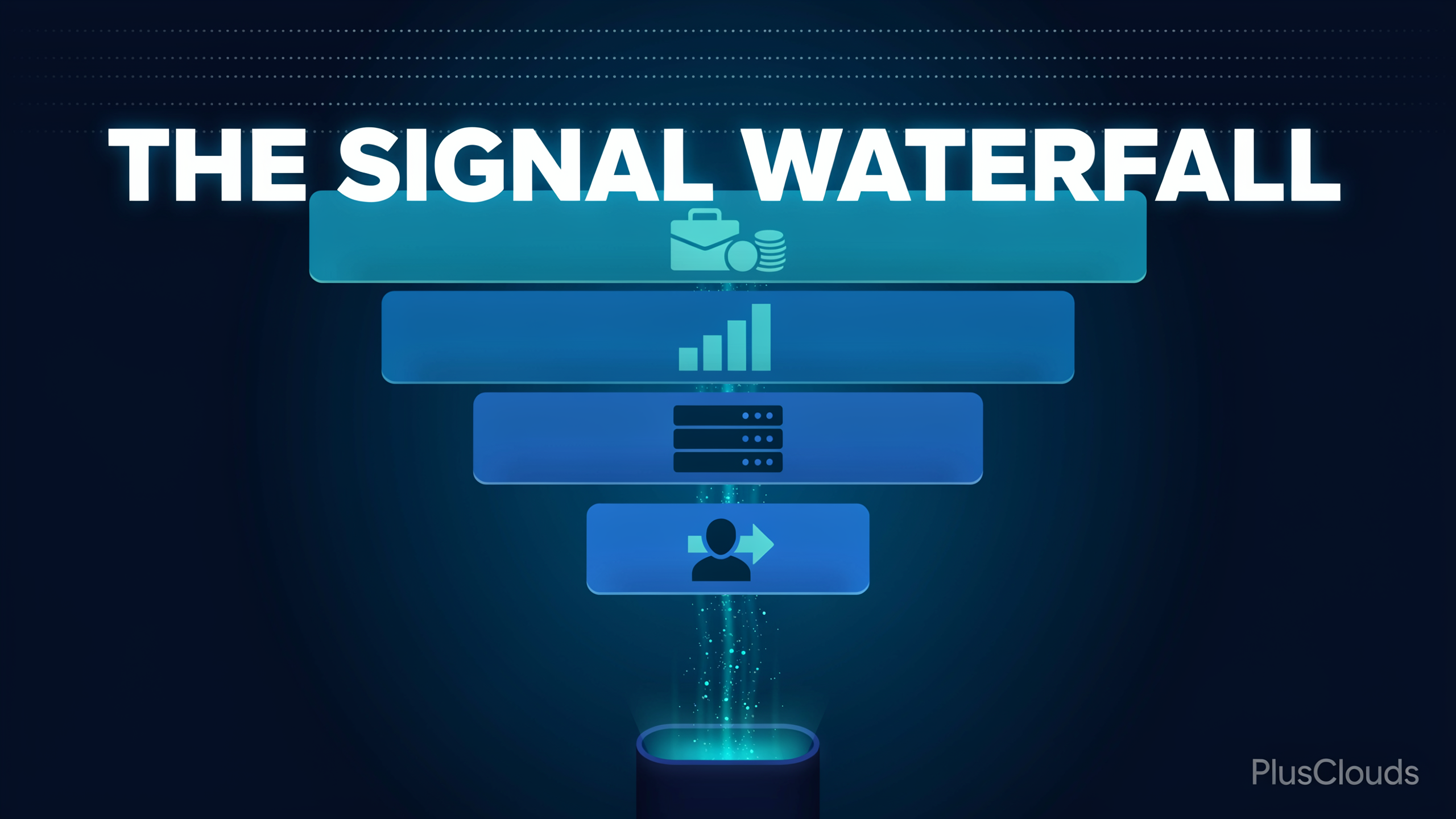
- A buying signal waterfall scores accounts against four signal classes (hiring, funding, technographic, job change), routes them into tiers, and re-scores them continuously as signals appear and decay.
- Funding signals open a buying window 4 to 10 weeks after announcement; job-change signals decay around 60 days; automation of decay logic is what keeps the pipeline from going stale.
Your SDR just sent an email to a VP of Engineering who changed jobs three weeks ago. The email says "Congratulations on the new role!" It got ignored. Not because the signal was wrong, but because the signal was alone. A job change by itself tells you someone moved, not that they are buying anything. The accounts actually in market right now are the ones showing three or four signals at once: a funding round, a hiring spree, a tech stack migration, and a new leader who owns the budget. If your prospecting system only catches one of those, you are competing for a sliver of the market while the rest stays invisible.
This article lays out a signal waterfall: a framework for B2B intent signal stacking that combines hiring, funding, technographic, and job-change signals into a prioritized, self-refreshing pipeline. We will cover what each signal class actually reveals, how to score and sequence them, how to configure LeadOcean to detect multiple signal classes simultaneously, and how to wire the whole thing into Eaglet and your CRM so it never goes stale.
Table of Contents
- Why Single-Signal Prospecting Leaves 70% of In-Market Buyers Invisible
- The Four Signal Classes in Signal-Based Selling: What Each One Reveals
- The Buying Signal Waterfall Model: Predictive Intent Scoring for B2B
- How to Configure LeadOcean Signal Detection for Multi-Class Intent Stacking
- Combining Signals With Eaglet: Signal-Based Outreach That Does Not Sound Creepy
- Reply Rate Benchmarks: One Signal Versus Three
- Keeping the Signal Waterfall Fresh: CRM Refresh Automation
- Failure Modes: The Three Ways Signal Stacking Goes Wrong and How to Avoid Them
- Worked Example: From Raw LeadOcean Signal Hit to Booked Meeting in 24 Hours
- Scaling B2B Pipeline Automation Across Multiple ICPs and Territories
Why Single-Signal Prospecting Leaves 70% of In-Market Buyers Invisible
Here is the uncomfortable math. At any given moment, roughly 3 to 5% of your total addressable market is actively in a buying cycle. The rest is dormant, but not uniformly dormant. Some accounts are warming up. They posted three backend engineering roles last month. They raised a Series B in Q1. They quietly swapped their analytics vendor.
If your trigger is "job change only," you catch the new executive, which is a real signal but a crowded one. Every vendor in your category saw the same LinkedIn update. If your trigger is "funding only," you catch the announcement-day flood and miss the actual buying window, which opens weeks later when the money starts being allocated.
The problem is structural. A single signal class has low specificity. Job changes happen constantly at every company. Funding rounds are rare but noisy. Any one signal, on its own, produces a list that is mostly wrong. So reps either ignore the list or blast it, and both options train the market to delete your emails.
Research on 2026 prospecting behavior backs this up: generic outreach sits around 3% reply rates, while outreach grounded in multiple, specific, recent signals lands in the 25 to 40% range according to industry analyses like Autobound's state of AI sales prospecting report. The gap is not effort. It is signal density. One signal is a guess. Three converging signals are a thesis.
The Four Signal Classes in Signal-Based Selling: What Each One Reveals
Before you can stack signals, you need to know what each one actually tells you. They are not interchangeable. Each class answers a different question about the account.
Hiring signals answer: where is this company investing headcount? A cluster of postings for data engineers says the data platform is a priority. Ten open sales roles says revenue expansion is the mandate. The most useful variant is the repeated posting: the same role reposted two or three times means they cannot fill it, which often means urgency, budget friction, or both. Either way, that pain is a conversation opener.
Funding signals answer: when does new budget arrive and who controls it? A Series B or a growth round means 12 to 18 months of allocated spend. The critical detail is the timing. The buying window does not open on announcement day. It opens 4 to 10 weeks later, once the CFO and the functional leaders agree on where the money goes. If you email the day TechCrunch publishes, you are one of forty emails. If you email in week six with a specific angle on their stated use of funds, you are the only one.
Technographic signals answer: what do they run, and what are they migrating away from? Job postings that mention "experience migrating from legacy monoliths" are a technographic confession. So are changes in their public tech stack, new vendor partnerships, or the appearance of a competitor's tool in their infrastructure. For anyone selling into cloud, DevOps, or data infrastructure, this is the highest-intent class available, because it describes the problem in the buyer's own words.
Job-change signals answer: who just became the person responsible for this problem? A new VP of Platform Engineering has 90 days of mandate, a fresh budget review, and zero loyalty to the incumbent vendor. This is the trigger most teams already use, which is exactly why it underperforms on its own. Everyone is emailing the new hire.
The pattern across all four: each class tells you something but no class tells you enough. Hiring tells you where the pain is. Funding tells you when the money exists. Technographics tell you what they are replacing. Job changes tell you who to talk to. Stack them and you have a complete sentence: this account, this buyer, this problem, this budget, this quarter.
The Buying Signal Waterfall Model: Predictive Intent Scoring for B2B
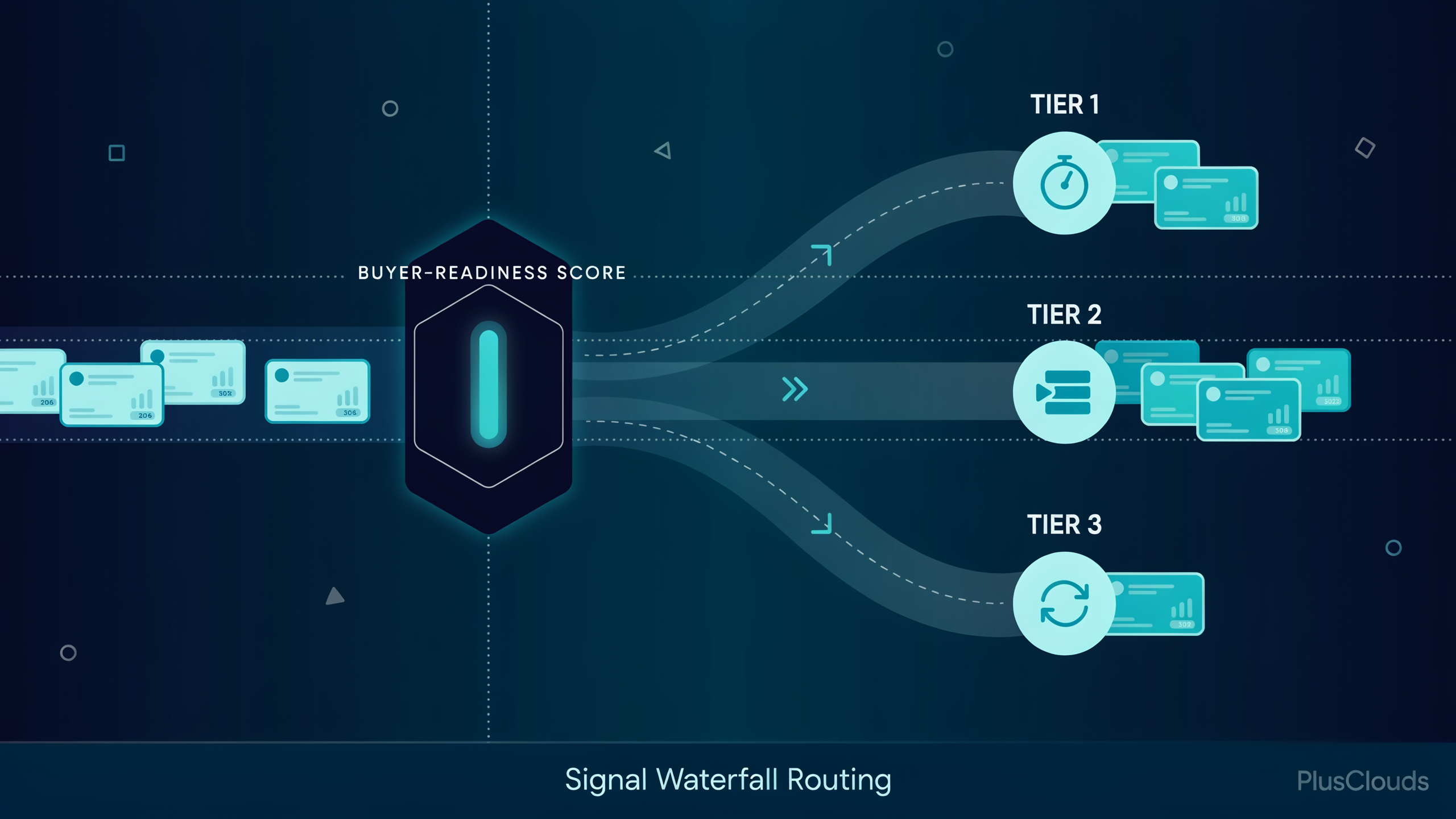
The waterfall is a scoring and routing system. Every account that enters your signal stream gets evaluated against all four classes, assigned a composite buyer-readiness score, and routed to a different play depending on where it lands.
Score each signal class on a 0 to 25 scale, weighted by how tightly it maps to your ICP (Ideal Customer Profile):
| Signal Class | Weight | High-Scoring Example |
|---|---|---|
| Technographic | 25 | Actively migrating off a tool you replace |
| Funding | 25 | Round closed 4-10 weeks ago, stated spend matches your category |
| Hiring | 20 | 5+ open roles in the function your product serves |
| Job change | 15 | New decision-maker in the buying role, within 90 days |
| ICP fit modifiers | 15 | Firmographics match your top-decile segment |
The waterfall then routes accounts into three tiers:
- Tier 1 (70+): human touch within 24 hours. Multiple high-weight signals converging. These get fully researched, personalized sequences from your best reps. Speed matters here; the window on a converging-signal account is days, not weeks.
- Tier 2 (40-69): automated multi-touch sequence. Two signals present. These go into Eaglet with signal-referenced templates and a human review before the first send.
- Tier 3 (below 40): nurture and re-score. One signal or none. These stay in a watchlist, and the waterfall re-scores them continuously. A Tier 3 account that posts five engineering roles next month becomes a Tier 1 account automatically.
The word "waterfall" describes the re-scoring behavior, not just the tiers. Accounts flow down when signals decay and up when new signals appear. A funding signal has a shelf life of roughly 90 days before its score contribution decays to zero. Job changes decay faster, around 60 days, because the new-executive window closes. Hiring signals decay slowest, since open roles persist for months. Your scoring model needs decay curves, not just point values, or your Tier 1 list fills up with stale accounts.
If you want a deeper treatment of what happens when signals decay and deals stall anyway, the pipeline velocity guide on buying signals and stalled deals covers the diagnostic side.
How to Configure LeadOcean Signal Detection for Multi-Class Intent Stacking
LeadOcean's AI Match Engine searches across 1.8 billion companies and detects buying signals across all four classes at once. The configuration work is deciding what "converging" means for your ICP, so the engine surfaces accounts where signals overlap rather than dumping every trigger hit into one undifferentiated list.
Start with the firmographic base layer. Define your ICP filters first (industry, headcount range, geography, revenue band) so every signal is evaluated only against accounts that could actually buy. If you have not built this layer yet, the ICP-to-pipeline flywheel guide walks through the filter design step by step.
Then configure the signal watchers. A practical setup for a B2B SaaS selling to mid-market engineering organizations:
- Hiring watcher: 3 or more open roles matching your buyer function within the last 30 days.
- Funding watcher: any round above your threshold (say $10M) closed within the last 10 weeks.
- Technographic watcher: job postings or public stack data indicating use of, or migration from, the tools adjacent to yours.
- Job-change watcher: new hires or role changes into your economic buyer title within the last 60 days.
The key configuration step is the composite rule. Instead of treating each watcher as an independent alert, set the engine to flag accounts meeting a combination: for example, hiring signal AND (funding OR job change) within a rolling 45-day window. That single rule is the difference between a list of 2,000 trigger hits and a list of 80 accounts where the signals actually converge.
Finally, map the output fields to your buyer-readiness score so each account arrives in your CRM pre-scored, with the contributing signals listed on the record. Your reps should never have to ask "why is this account in my queue?" The answer should be on the record itself.
Combining Signals With Eaglet: Signal-Based Outreach That Does Not Sound Creepy
Detecting signals is half the system. The other half is referencing them in outreach without making the buyer feel surveilled. There is a bright line here, and it runs between public and inferred.
Public signals are fair game in the first sentence: funding announcements, public job postings, published tech stack data, LinkedIn role changes. These are things the company chose to make visible. Referencing them reads as diligence.
Inferred signals (your scoring model's conclusion that the account is "in a buying window") should never appear in copy. Nobody wants to hear "our AI determined you are 78% likely to buy." The score routes the account; the copy references the underlying public facts.
Eaglet handles the sequencing layer, and its useful property here is signal-to-template mapping. Each signal class gets its own opening pattern:
- Funding: "Saw the Series B close last month. Usually at this stage the first thing teams staff up for is [problem your product solves]. Is that where the new headcount is going?"
- Hiring: "You have 6 open platform engineering roles. That usually means the infra roadmap is about to get ambitious. What is the first thing on it?"
- Technographic: "Noticed a few of your job posts mention migrating off [legacy tool]. That migration usually surfaces [specific pain]. Worth 15 minutes?"
- Job change: "Congrats on the move. New platform leaders usually inherit a stack they did not choose. Curious what you kept and what you are already replacing."
When signals stack, reference the strongest two, not all four. "Saw the Series B and the six open data roles" is specific and human. Listing every signal you detected reads like a report, not an email. Eaglet's CRM sync keeps the sequence state attached to the account record, so if a Tier 1 account gets human outreach and goes quiet, it can drop back into an automated nurture without anyone manually reassigning it. For the full channel strategy around this, the omnichannel LeadOcean and Eaglet sequence guide covers email, LinkedIn, and phone coordination.
Reply Rate Benchmarks: One Signal Versus Three
The pattern across the 2026 research is consistent: signal count correlates with reply rate, but with a condition. The signals have to be related. Three random signals about an account are noise. Three signals that tell one coherent story are a thesis, and theses get replies.
The numbers reported across recent industry analyses:
- Generic, unpersonalized outreach: roughly 1 to 3% reply rates.
- Single-signal personalization (name plus one trigger reference): 8 to 12%.
- Multi-signal, coherent-story personalization: 25 to 40%, per 2026 AI prospecting benchmarks and R-Sun's analysis of AI-driven B2B sales.
The coherence condition matters more than the count. "Congrats on the funding, and I see you are hiring, and you use Salesforce" is three disconnected observations. "You raised to expand the platform team, you have six open infra roles, and your job posts mention migrating off your current observability stack" is one story about a company building something and running into a problem you solve. The second email gets replies because the buyer reads it and thinks this person understands what is happening here.
There is also a speed multiplier. The same multi-signal email sent in week one of the buying window versus week eight produces materially different outcomes, which is why the waterfall's Tier 1 routing demands 24-hour response. We covered the timing mechanics in detail in the 48-hour activation window article.
Keeping the Signal Waterfall Fresh: CRM Refresh Automation
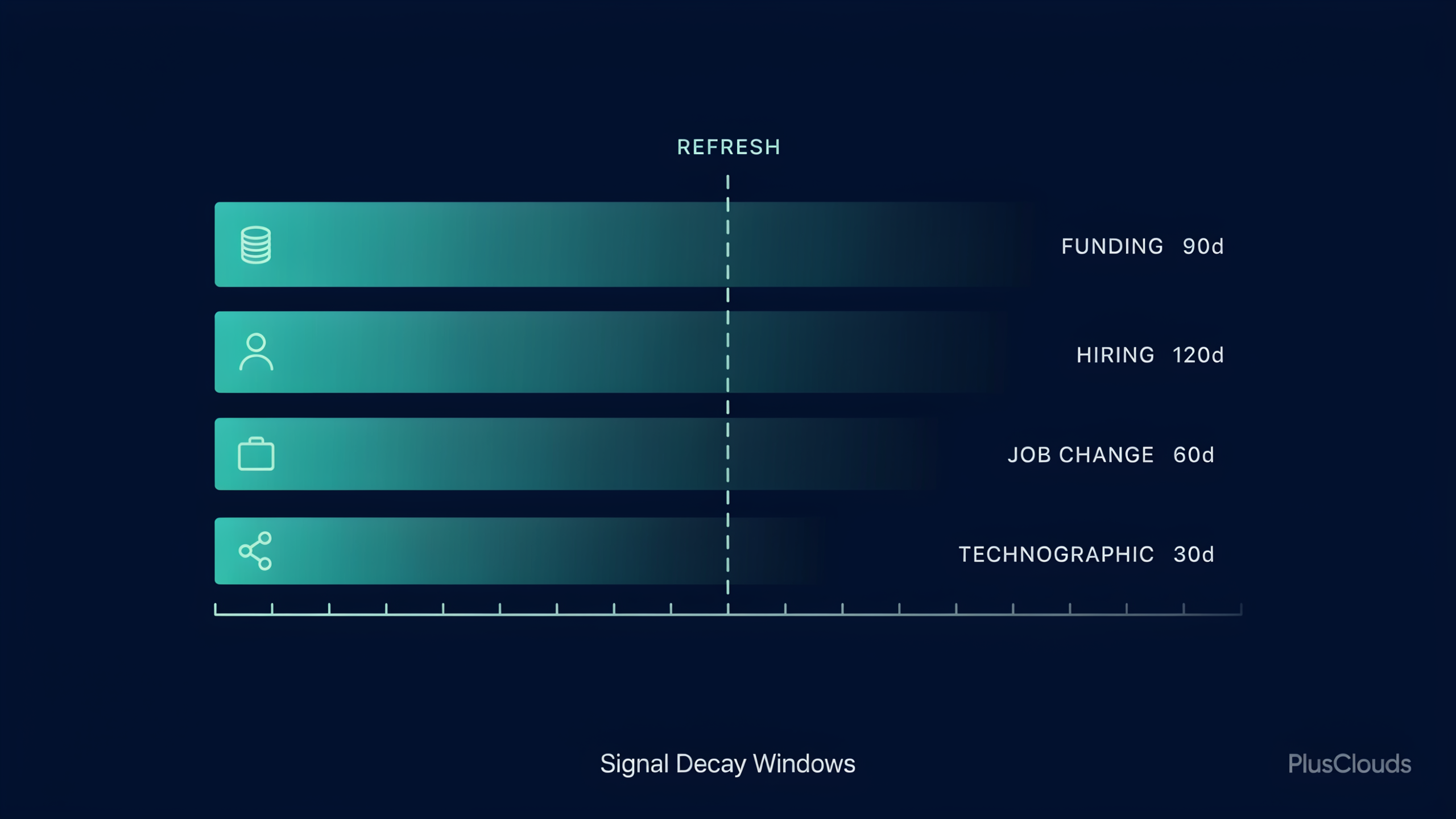
A waterfall is only as good as its freshness. Signal scores decay, and if nobody updates them, your Tier 1 list becomes a museum of last quarter's opportunities. The fix is automation, and it lives in the CRM integration, not in anyone's calendar.
LeadOcean's native HubSpot and Salesforce connectors let you sync signal data as account properties. Set up the sync so each signal class writes a timestamped field: last_funding_signal_date, last_hiring_signal_date, last_technographic_signal_date, last_job_change_signal_date. Then build decay logic on top:
buyer_readiness_score =
  (technographic: 25 if age < 30d, 12 if < 60d, 0 otherwise) +
  (funding: 25 if age < 45d, 10 if < 90d, 0 otherwise) +
  (hiring: 20 if age < 60d, 8 if < 120d, 0 otherwise) +
  (job_change: 15 if age < 30d, 6 if < 60d, 0 otherwise) +
  (icp_fit_modifier: 0-15, static)
In HubSpot this is a calculated property with a daily recalculation. In Salesforce it is a scheduled Flow or a nightly Apex job. Either way, the score updates itself, and list membership follows: accounts above 70 flow into the Tier 1 queue, accounts that decay below 40 flow out. Nobody re-scores anything by hand.
Two operational details worth getting right. First, sync cadence: signal watchers should push to the CRM at least daily, because a funding signal that arrives on Monday and reaches your reps on Friday has already burned four days of its window. Second, closed-loop feedback: when an account books a meeting or goes dark, write that outcome back so the scoring model can be tuned. If you find that job-change-only accounts never convert but technographic-plus-hiring accounts convert at 4x, your weights should learn that.
Failure Modes: The Three Ways Signal Stacking Goes Wrong and How to Avoid Them
The waterfall fails in predictable ways. All three are avoidable if you know what to watch for.
1. Signal spam. The team discovers stacking, gets excited, and references four signals in every email. The result reads like a surveillance report and performs worse than single-signal outreach. The fix is the coherence rule from earlier: reference the two strongest signals, and only if they tell a connected story. If they do not connect, use one.
2. Stale scores. The waterfall is built, it works for six weeks, and then quietly rots because decay logic was never automated and the person who built the scoring sheet left the company. Signals have shelf lives. A funding signal from five months ago is not a signal; it is trivia. Automate the decay or the whole system degrades into the single-trigger lists you started with.
3. Signal volume without capacity. Multi-signal stacking will surface more Tier 1 accounts than your rep team can personally touch. This is a good problem, but an unmanaged one: reps start triaging by gut feel, the 24-hour SLA slips, and the speed advantage evaporates. The fix is capacity planning before you widen the signal net. If the waterfall produces 60 Tier 1 accounts a week and your team can genuinely work 30, tighten the composite rule (raise the threshold, narrow the ICP) rather than letting the queue silently overflow. A smaller list worked at full speed beats a bigger list worked at half speed.
Worked Example: From Raw LeadOcean Signal Hit to Booked Meeting in 24 Hours
Here is the waterfall end to end with a realistic account.
Hour 0. LeadOcean's morning sync pushes a new composite hit: a 400-person fintech company, matching your ICP filters, flagged for three converging signals within a 30-day window. A $24M Series B closed 5 weeks ago. Four senior platform engineering roles posted. A new VP of Engineering started 12 days ago. Buyer-readiness score: 82. Tier 1.
Hour 1. The account lands in the Tier 1 queue in HubSpot with the signal breakdown on the record. The assigned SDR spends 20 minutes on research: the funding announcement names platform investment as a stated use of funds, and two of the engineering job posts mention migrating event-streaming infrastructure.
Hour 3. The SDR drafts the opener in Eaglet, referencing the two connected signals: the funding round's stated platform investment and the streaming migration visible in the job posts. Eaglet schedules the email for the next morning in the buyer's timezone, with a LinkedIn view queued for day 3 and a call task for day 5 if there is no reply.
Hour 19. The email sends at 8:40 AM local time. It opens with the funding angle, names the migration problem specifically, and asks one question about the platform roadmap.
Hour 23. The VP of Engineering replies: "This is timely, we are mid-migration. Thursday afternoon works."
Hour 24. Meeting booked. The rep walks in already knowing the budget exists, the mandate is public, the problem is named, and the buyer is new enough to want wins. That is not luck. That is the waterfall doing its job.
Scaling B2B Pipeline Automation Across Multiple ICPs and Territories
The waterfall that works for one ICP does not automatically work for ten. Three things change.
First, scoring weights become ICP-specific. A funding signal is a strong predictor for an early-stage SaaS ICP and a weak one for enterprise banking, where budget cycles follow fiscal years, not funding rounds. Each ICP needs its own weight table, maintained as its own configuration rather than a single global score.
Second, routing becomes territorial. With five territories, the same account can hit Tier 1 in two regions' queues. Territory rules need to sit above the waterfall: assign ownership at the account level before signals route, so two reps never email the same buyer with different angles in the same week.
Third, review cadence becomes a real operational discipline. With one ICP, you can eyeball the system monthly. With ten, you need a weekly review of score distribution, tier conversion rates, and decay accuracy per ICP, or one broken weight table silently poisons one segment for a quarter. The teams that scale this well treat the waterfall as infrastructure: versioned, monitored, and changed deliberately. If you are building toward a predictable coverage model across segments, the 3x pipeline coverage guide pairs well with this framework.
The principle underneath all of it stays the same. Buyers do not emit one signal when they are ready to buy. They emit a pattern. Build a system that reads the pattern, scores it, routes it, and refreshes it, and your pipeline stops depending on whoever emails fastest on announcement day.
LeadOcean detects the converging signals across 1.8 billion companies and scores them against your ICP; Eaglet turns the top of the waterfall into sequences that reference the right signal at the right moment. If you want to see how the waterfall performs against your current single-trigger setup, start with one composite rule and one ICP, and expand from there.