Your compliance officer forwards you a NIS2 transposition update at 4:40 PM on a Friday. The subject line reads "we need to talk about our hosting." You open your cloud console and realize you cannot answer a basic question: where, physically, does your production data sit, and can your provider prove it stays there?
Sound familiar? You are not alone. NIS2 enforcement timelines land in late 2025, and hosting providers are now squarely in scope as critical service suppliers. This guide is a decision framework and compliance checklist for choosing EU data residency hosting that satisfies GDPR, NIS2, and your board at the same time.
Table of Contents
- Key Takeaways
- What NIS2 Actually Requires of Hosting Providers in 2025
- Data Residency vs. Data Sovereignty for EU Hosting
- GDPR Article 32 Technical Requirements for Cloud Hosting
- How to Audit a Provider's EU Compliance Posture
- Country-Specific EU Hosting Considerations
- EU Hosting Compliance Checklist Template
- Conclusion: Making the EU Hosting Decision
Key Takeaways
- NIS2 pulls hosting providers into the regulated supply chain, which means your provider's incident reporting duties become part of your own risk documentation.
- Data residency (where data is stored) and data sovereignty (which legal system controls it) are different questions, and US CLOUD Act exposure means an EU region alone does not answer the second one.
- GDPR Article 32 maps to concrete, testable hosting controls: encryption, segmentation, backup recovery, and continuous resilience testing.
- A structured provider audit takes about two weeks and produces evidence you can hand directly to a supervisory authority or enterprise customer.
What NIS2 Actually Requires of Hosting Providers in 2025
NIS2 is not a security certification. It is an incident response and accountability regime, and hosting providers are named as important or essential entities under Annex I and II. The ENISA overview of the NIS directive lays out the scope, but the practical obligations for your provider boil down to four things.
First, risk management measures. Article 21 requires a documented, all-hazards security regime covering network security, supply chain security, cryptography, access control, and business continuity. Not "we have firewalls." Documented, reviewed, and evidenced.
Second, incident reporting on a clock. Significant incidents must trigger an early warning within 24 hours, an incident notification within 72 hours, and a final report within one month. If your provider gets breached, that clock runs, and your own incident response depends on their cooperation.
Third, management accountability. Under Article 20, governing bodies must formally approve risk measures and can be held personally liable for failures. This is why boards are suddenly asking CISOs pointed questions about hosting contracts.
Fourth, supply chain security. This is the part that reaches you. Your provider is obligated to assess your relationship as part of their supply chain risk, and you are obligated to assess theirs. The directive effectively makes the provider-customer relationship a two-way documented control, not a standard SLA PDF.
The enforcement consequence is simple: if you host with a provider that cannot produce NIS2-grade evidence, you inherit a gap in your own audit. For a deeper treatment of the joint obligations, see our NIS2 and DORA cloud infrastructure checklist.
Data Residency vs. Data Sovereignty for EU Hosting
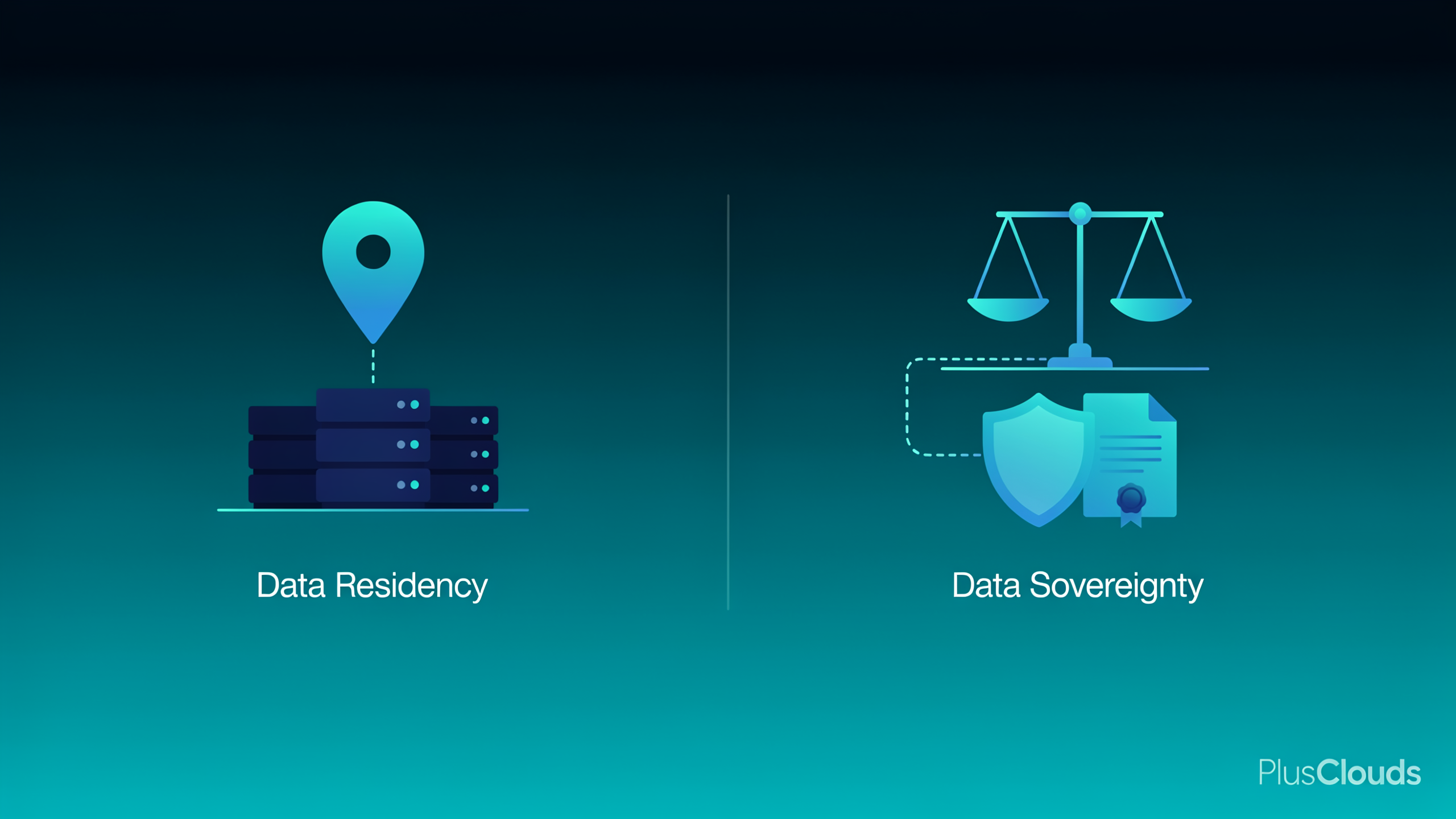
These terms get used interchangeably in vendor marketing, and that ambiguity costs money when the auditor arrives.
Data residency answers a geographic question: where do the bytes physically live? If your database runs in an EU region, residency is satisfied. Most major providers can tick this box.
Data sovereignty answers a legal question: whose law can compel access to those bytes? This is where it gets uncomfortable. A workload in a Frankfurt region operated by a US-headquartered hyperscaler sits under EU data protection law for GDPR purposes, but the US CLOUD Act creates a lawful access pathway that EU regulators have repeatedly flagged. Schrems II made this a transfer risk, not a theoretical one.
The practical distinction looks like this:
| Question | Residency answer | Sovereignty answer |
|---|---|---|
| Where is data stored? | EU region | EU region |
| Who operates the infrastructure? | Any provider | EU-based legal entity with EU ownership and control |
| Whose courts can compel disclosure? | Depends on provider nationality | EU jurisdictions only |
| Where are support and admin operations? | Often global | EU-based, or contractually ring-fenced |
| Where do backups live? | Frequently overlooked | EU, explicitly contracted |
That last row is the classic audit finding. Teams verify the primary region, then discover replication or backups quietly land in a US zone. Contract language should name every storage location, including backups, replicas, and logs.
If your workloads carry national-level sensitivity (health records, public sector, defense-adjacent data), sovereignty is not optional, and our guide on keeping workloads inside national borders without sacrificing performance walks through the architecture options. For most commercial workloads, residency plus contractual safeguards is the defensible baseline; sovereignty-grade isolation is the upgrade you justify by data classification, not by fear.
GDPR Article 32 Technical Requirements for Cloud Hosting
Article 32 requires "appropriate technical and organisational measures" for security of processing. Vague on paper, concrete in practice. Regulators and enterprise customers evaluate it against specific, testable controls, and the GDPR hosting and data residency compliance guide breaks down how these map to hosting arrangements. Here is the translation into infrastructure terms.
Encryption. Data at rest encrypted with keys you control or at least can rotate; data in transit encrypted end to end, not just at the edge. Ask where key management happens and who can access key material.
Pseudonymization and access control. Role-based access with least privilege, MFA on all administrative access, and logged session activity. Shared root credentials are an automatic finding.
Confidentiality and integrity. Network segmentation that separates production from management planes, stateful filtering, and protection against the OWASP Top 10 attack classes at the application layer.
Availability and resilience. This is the one teams underestimate. Article 32 explicitly covers "a process for regularly testing, assessing and evaluating" security measures, which courts and regulators have read to include recovery capability. An untested backup is not a control; it is a hope. Our immutable, air-gapped backup blueprint covers how to design a recovery layer that satisfies both GDPR resilience language and NIS2 Article 21.
A provider helps you meet Article 32, but it does not absorb the obligation. As the data controller (or processor, depending on your role), you remain accountable for configuration. A compliant provider with a misconfigured customer is still a breach scenario, which is why our piece on cloud misconfiguration as the top security risk pairs so directly with any hosting decision.
How to Audit a Provider's EU Compliance Posture
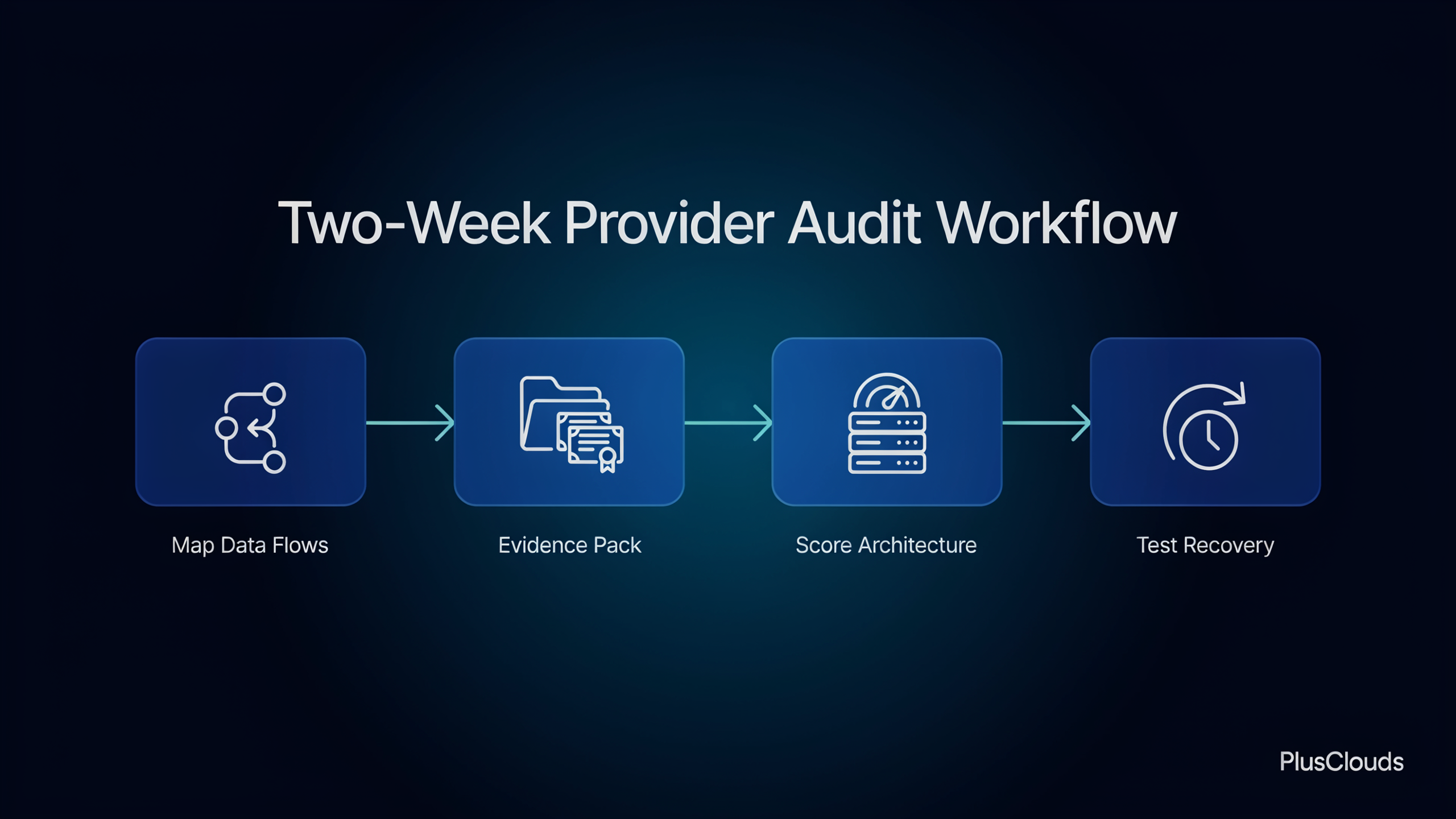
You can evaluate a provider in about two weeks with a structured process. Do not accept a trust page and a logo wall; request evidence.
Step 1: Map your data flows (days 1 to 2). Inventory what personal data and regulated data touches the provider, where it enters, where it is processed, stored, replicated, and backed up. This becomes your records of processing input and your scope for everything else.
Step 2: Request the evidence pack (days 2 to 5). Specifically ask for:
- ISO 27001 and SOC 2 certificates with scope statements covering the actual data centers you will use
- A GDPR-compliant data processing agreement naming sub-processors, storage locations, and breach notification timelines
- NIS2 incident reporting commitments written into the contract, not a marketing claim
- Data center certifications (Tier level, redundancy design, physical security audits)
- Penetration test summaries and a documented vulnerability management process
- Backup and recovery documentation with explicit RPO and RTO commitments
Step 3: Score the architecture (days 5 to 10). Evaluate the technical platform against your Article 32 requirements: encryption defaults, key management, network segmentation options, firewall and WAF capabilities, DDoS protection, and logging export. A provider that gives you five network types (public, private, VPN, management, DMZ) from a single control plane, like PlusClouds' networking and load balancer infrastructure, makes segmentation evidence straightforward because the zones are first-class objects rather than ad hoc VPC spaghetti.
Step 4: Test the recovery story (days 10 to 14). Run a restore. Not a tabletop exercise, an actual restore of a real workload to a point in time. Measure it against the RTO in the contract. If the provider cannot support a test restore, that is your answer.
This process produces two outputs: a scored decision, and a binder of evidence you can reuse for your own NIS2 and GDPR documentation. For the broader picture of meeting GDPR, NIS2, and SOC 2 without over-engineering, our unified cloud compliance guide extends this framework across the full regulatory stack.
Country-Specific EU Hosting Considerations
"EU hosting" is not a monolith. The directive is harmonized, but enforcement culture, data center density, and national cloud strategies differ meaningfully.
Germany runs the strictest enforcement environment in the EU, with active supervisory authorities and a strong expectation of documented technical controls. German customers often prefer providers with in-country infrastructure, and the Federal Data Protection Commissioner's guidance effectively sets the tone for the region. If you sell into German enterprises, hosting in or near Germany removes an objection before it is raised.
Netherlands offers dense connectivity (AMS-IX is one of the world's largest internet exchanges), strong English-language contracting, and a mature data center market. A common choice for pan-EU workloads.
France has a formal sovereign cloud strategy (SecNumCloud certification) and public sector workloads increasingly require it. Commercial workloads face lighter requirements, but French enterprises read contracts with sovereignty in mind.
Türkiye and Southeast Europe sit outside the EU regulatory perimeter, which matters: hosting there does not satisfy EU residency for GDPR purposes without additional transfer safeguards, and NIS2 does not apply to providers outside the scope. If you serve EU customers from outside the bloc, you carry the full Article 44 international transfer burden yourself.
Nordics combine strong privacy culture with excellent renewable-powered infrastructure, relevant if sustainability reporting is part of your procurement story.
Two practical rules. First, match the country to your customer concentration and data classification, not to price. Second, verify the provider's legal entity location, not just the data center location; a Dutch data center run from a non-EU parent reopens the sovereignty question.
EU Hosting Compliance Checklist Template
Here is the consolidated checklist. Score each item: documented evidence, verbal assurance, or gap. Anything short of documented evidence is a gap for audit purposes.
Provider governance
- Legal entity established in the EU, with ownership structure disclosed
- ISO 27001 and SOC 2 certificates in scope for the specific data centers you will use
- GDPR data processing agreement signed, naming all sub-processors and locations
- NIS2 incident reporting commitments (24-hour early warning, 72-hour notification) in the contract
- Named security contact and escalation path, tested once
Data location and sovereignty
- Primary, replica, backup, and log storage locations all contractually pinned to the EU
- Support and administrative access locations documented
- CLOUD Act exposure assessed and accepted or mitigated
- Data classification confirms whether residency or full sovereignty is required
Technical controls (Article 32 mapping)
- Encryption at rest and in transit, with documented key management
- MFA on all administrative access, no shared credentials
- Network segmentation available: separate management, private, and DMZ zones
- Stateful firewall and WAF coverage against OWASP Top 10
- DDoS mitigation always-on, not burst-triggered
- Logging exportable to your own systems
Resilience and recovery
- Backup automation with explicit RPO and RTO targets in the SLA
- Restore capability tested by you, on your workloads, at least annually
- Immutable or air-gapped backup tier for ransomware resilience
- Data center Tier 3 or equivalent, with N+1 redundancy documented
Ongoing verification
- Annual review of sub-processor list and certificates
- Provider penetration test summaries reviewed yearly
- Exit plan documented: how you extract data and delete provider-side copies
This is deliberately the same structure an auditor walks. If you can produce evidence for each line, a NIS2 or GDPR review of your hosting arrangement becomes a document retrieval exercise instead of a crisis. A provider like PlusClouds, operating Tier 3 EU data centers with N+1 redundancy and a 40 Gbps backbone, is built to answer most of this list from a single evidence pack rather than a procurement negotiation.
Conclusion: Making the EU Hosting Decision
Back to the Friday afternoon message. The difference between panic and a two-week structured audit is whether you already know where your data lives, whose law governs it, and what your provider can prove. NIS2 turned those questions from procurement details into board-level accountability, and the providers who can produce evidence on demand are now part of your compliance perimeter, not just your infrastructure bill.
Run the checklist against your current provider first. If the gaps cluster around sovereignty, recovery evidence, or incident reporting commitments, evaluate an EU-native alternative against the same list. We invite you to put PlusClouds' EU data centers, Cloud Servers, and networking infrastructure through this exact checklist and see how the evidence pack holds up.
Tags: NIS2, GDPR, data residency, data sovereignty, EU hosting, compliance checklist